Concrete is the most widely used building material in the world and is employed in nearly every type of construction project. It is a crucial construction material due to its exceptional durability, strength, and extreme longevity. It can resist compressive and tensile stress and harsh weather conditions without compromising its architectural stability.
Fiber-reinforced concrete is concrete containing fibrous material, which increases its structural integrity. It consists of short, discrete fibers that are uniformly distributed and randomly oriented.
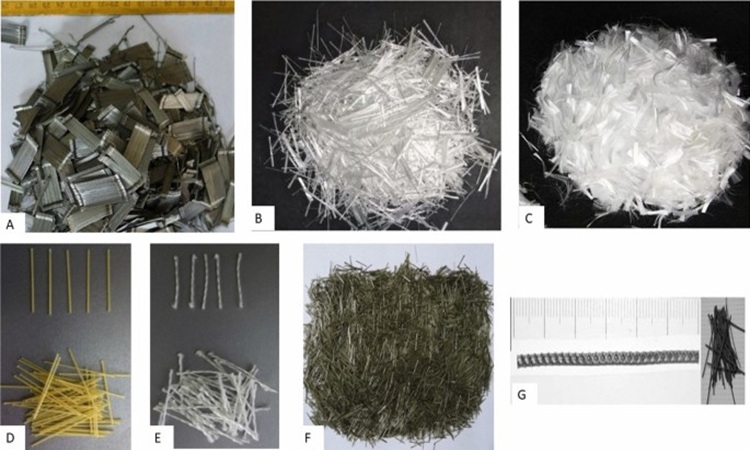
Fibers include steel fibers, glass fibers, basalt, nylon, polyethylene fibers, synthetic fibers, and natural fibers.
Mixing fibers with concrete helps to reduce cracking in the concrete and increases its overall energy absorption and structural integrity. The fibers are not used as a replacement for stainless steel-reinforced concrete; however, as they are not responsible for flexural strength, or the ability for concrete to bend without breaking.
Fiber is a small piece of reinforcing material possessing certain properties. Fiber reinforcement is mainly used in shotcrete, but can also be used in normal concrete.
Concrete reinforced with fibers is less expensive than conventional reinforcements, while still increasing the tensile strength significantly.
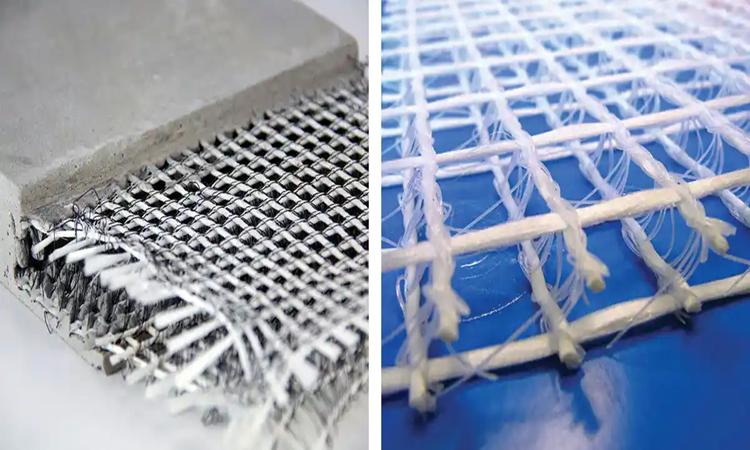
Continuous meshes, woven fabrics, and long wires or rods are not considered to be discrete fibers.
The fibers are commonly described by a convenient parameter called the “Aspect Ratio.” The term aspect ratio of the fiber is the ratio of length to the diameter of the fiber. Normally, the aspect ratio ranges from 30 to 150.
Fiber-reinforced normal concrete is mostly utilized for on-ground floors and pavements, but can be considered for a wide range of construction parts (beams, piers, foundations, etc)
Historical Development of Fiber-Reinforced Concrete
The concept of utilizing fibers as reinforcement in the concrete mix is not new. Fibers have been utilized as reinforcement since ancient times.
Historically, horsehair was utilized in mortar. In the 1900s, asbestos fibers were utilized in the concrete mix.
In a time of the 1950s, the concept of composite materials came into being & fiber-reinforced concrete was one of the topics of interest.
By the 1960s, steel, glass, and synthetic (such as polypropylene) fibers were utilized in the concrete mix.
In the 1970s, fiber reinforcement was accepted as a practical alternative to traditional reinforcement.
Then Ramakrishna replaced straight steel fibers with hooked ends. Microfibers became widely accepted as they were good at controlling plastic shrinkage. But they did not produce sufficient strength.
Macro synthetic fibers such as nylon, polyester, polyethylene, & cellulose were also utilized.
Carbon fibers have high strength & have been used in Japan in several buildings. Natural fibers such as sisal, coconut, jute, and bamboo are also under research because they lack durability in alkaline environments.
Types of Fiber-Reinforced Concrete
There are several types of fibers utilized in reinforced concrete. Descriptions of the most common types follow:
Cellulose Fibers
Cellulose fibers are made with ethers or esters of cellulose, which can be obtained from the bark, wood, leaves of plants, or other plant-based materials. In addition to cellulose, the fibers may also consist of hemicellulose and lignin, with variant percentages of these components altering the mechanical properties of the fibers. The main functions of cellulose fibers are in the textile industry, as chemical filters, and as fiber reinforcement, due to their similar properties to engineered fibers, being another option for biocomposites and polymer composites.
Natural Fibers
These natural fibers are directly obtainable from an animal, vegetable, or mineral source & changeable into nonwoven fabrics such as felt or paper or, after spinning into yarns, into woven cloth. Natural fiber may be defined as an agglomeration of cells in which the diameter is negligible in comparison with the length. Nature abounds in fibrous materials, especially cellulosic types such as cotton, wood, grains, and straw. The utilization of natural fibers in making concrete is recommended since several types of these fibers are available locally and are plentiful. The idea of utilizing such fibers to improve the strength & durability of brittle materials is not new in construction; for example, straw and horsehair are used to make bricks and plaster. Natural fibers are suitable for reinforcing concrete & are easily available in developing countries.
Carbon Fibers
This type of fiber is composed mainly of carbon atoms with a diameter of 5 micrometers to 10 micrometers. Carbon fibers are also mixed with other materials, such as graphite, to form reinforced carbon composites, which have a very high heat tolerance. There are many advantages to using carbon fibers; they include but are not limited to, the following:
- It has a low thermal expansion.
- It has high chemical resistance.
- Carbon fibers have a high-temperature tolerance.
- They are stiff, low-weight, and have high tensile strength.
Polyester Fibers
Polyester fibers are the preferred choice for warehouses and other industrial floors, pavements, and precast products. Polyester macro & microfibers are mixed with concrete to ensure structural integrity, toughness, and to protect against plastic shrinkage cracks. Polyester micro- and macro-fibers are used in concrete to provide superior resistance to the formation of plastic shrinkage cracks versus welded wire fabric & to increase the toughness and the ability to deliver structural capacity when properly designed, respectively.
Glass Fibers
Glass fiber shares many mechanical features & properties with other fibers like carbon fiber and polymer fiber. Glass fiber reinforced concrete (GFRC) is a material containing numerous extremely fine fibers of glass. Glass fibers are therefore utilized as a reinforcing agent for many polymer products; to form a very strong & relatively lightweight fiber-reinforced polymer (FRP) composite material called glass-reinforced plastic (GRP), also popularly known as “fiberglass”. This material contains little or no air or gas, is denser, and is a much poorer thermal insulator than glass wool.
Polypropylene Fiber
Polypropylene-type fiber is utilized in concrete because it is resistant to drying shrinkage & plastic shrinkage. This fiber helps reduce water bleeding in concrete and reduces the concrete’s permeability significantly. Polypropylene is a synthetic fiber that is derived from propylene and is used in a variety of applications. These fibers are usually utilized in concrete to control cracking due to plastic shrinkage and drying shrinkage. They also lessen the permeability of concrete & thus reduce the bleeding of water. Polypropylene fiber belongs to the polyolefin group and is partially crystalline and non-polar. It has homogeneous properties as polyethylene, but it is harder and more heat resistant. Polypropylene is produced from propylene gas in the presence of a catalyst such as titanium chloride. Polypropylene fiber displays good heat-insulating properties and is highly resistant to acids, alkalis, and organic solvents.
Steel Fiber
Steel fiber is a metal reinforcement. A certain amount of steel fiber in concrete can cause qualitative changes in concrete’s physical properties. It can greatly increase resistance to cracking, impact, fatigue, bending, tenacity, durability, and others. For improving long-term behavior and enhancing strength, toughness, and stress resistance, SFRC is being utilized in structures such as flooring, housing, precast, bridges, tunneling, heavy-duty pavement, and mining. The types of steel fibers defined by ASTM A820 are, Type I: cold-drawn wire, Type II; cut-sheet, & Type III: melt-extracted, Type IV: mill cut, and Type V: modified cold-drawn wire.
Advantages of Fiber-reinforced concrete
- Fiber-reinforced concrete may be useful where high tensile strength and reduced cracking are desirable or when conventional reinforcement steel cannot be placed.
- It enhances the impact strength of concrete, limits crack growth, and leads to a greater strain capacity of the composite material.
- For industrial constructions, macro-synthetic fibers are used to improve concrete’s durability. Manufactured from synthetic materials, these fibers are long and thick in size and may be used as a replacement for bar or fabric reinforcement steel.
- Mixing fibers into the concrete will improve its freeze-thaw resistance and help keep the concrete strong and attractive for extended periods.
- Enhances the mix cohesion, improving pump ability over long distances.
- Improve resistance to plastic shrinkage during curing.
- Minimizes the requirements of steel reinforcement.
- Minimizes the crack widths tightly, thus improving the durability of the structure.
- Reduces segregation and bleed-water
- The toughness of the FRC is about 10 to 40 times that of plain concrete.
- The mixing of fibers increases fatigue strength.
- Fibers increase the shear capacity of reinforced concrete beams.
Disadvantages of Fiber-reinforced concrete
- Must be mixed carefully. The fibers used in fiber-reinforced concrete must be dispersed meticulously and uniformly throughout the concrete mix. The safety margin for mixing fiber-reinforced concrete can be high if done improperly. The fibers must not bunch up, which can be monitored, but there is always the possibility of fibers orienting in a way that causes the dispersion to be inconsistent.
- Cost. Compared with non-reinforced concrete, fiber-reinforced concrete is more expensive. However, it should be kept in mind that most concrete mix is reinforced in some way, and many projects require it.
- Weight. Mixing fibers into the concrete will make it heavier than a plain concrete mix, generally. This adds more weight to the overall structure, meaning an engineer needs to plan for this weight to maintain structural integrity.
- An increase in the number of fibers can reduce workability and can cause a finishing problem.
- Based on the type of fiber material, the surface texture can be fuzzy and hence difficult to paint. You may be required to use a floor polisher before you can paint or do epoxy flooring.
- Steel fibers are liable to clumping in ready-mix trucks, leading to balls of fiber concentrated in one portion of the pour, with no fiber present in other areas.
Mechanical Properties of FRC
The addition of fibers to concrete influences its mechanical properties, which significantly depend on the type and percentage of fiber. Fibers with end anchorage & high aspect ratio were found to have improved effectiveness. It was shown that for the same length and diameter, crimped-end fibers can achieve the same properties as straight fibers using 40 percent fewer fibers. In examining the mechanical properties of FRC, the same equipment and procedure as used for conventional concrete can also be used. Below are some properties of FRC determined by different researchers.
Compressive Strength
The presence of fibers may alter the failure mode of cylinders, but the effect of fiber will be minor on the improvement of compressive strength values (0 to 15 percent).
Modulus of Elasticity
FRC’s modulus of elasticity increases slightly with fiber content. It was found that for each 1 % increase in fiber content by volume, there is an increase of 3 % in the modulus of elasticity.
Flexure
The flexural strength was reported to be increased by 2.5 times utilizing 4 % fibers.
Toughness
For FRC, toughness is about 10 to 40 times that of plain concrete.
Splitting Tensile Strength
The mixing of 3 % fiber by volume was reported to increase the splitting tensile strength of mortar by about 2.5 times that of the unreinforced concrete.
Fatigue Strength
The addition of fibers increases fatigue strength by about 90 percent and 70 percent of the static strength at 2 x 10⁶ cycles for non-reverse and full reversal of loading, respectively.
Impact Resistance
The impact strength for fibrous concrete is generally 5 to 10 times that of plain concrete, depending on the volume of fiber used.
Corrosion of Steel Fibers
A 10-year exposure of steel fibrous mortar to outdoor weathering in an industrial atmosphere showed no adverse effect on the strength properties. Corrosion was found to be confined only to fibers exposed on the surface. Steel fibrous mortar continuously immersed in seawater for 10 years exhibited a 15 percent loss compared to a 40 percent strength decrease of plain mortar.
Applications of Fiber Reinforced Concrete
Generally, in structural applications, FRC should only be used in a supplementary role to inhibit cracking, improve resistance to impact, to resist dynamic loading and material disintegration. In structural members where considerable flexural & axial tensile stresses occur, such as in beams, columns, suspended/roof slabs, etc., steel fibers alone are insufficient and should never be wholly used to replace traditional steel reinforcements. Some of the more appropriate examples of general structural and non-structural uses of FRC are listed as follows:
Runway, Aircraft Parking, and Pavements
For the same wheel load, FRC slabs could be about one-half the thickness of a plain concrete slab. Compared to a 375mm thickness of the conventionally reinforced concrete slab, a 150mm thick crimped-end fiber-reinforced concrete slab was used to overlay an existing asphaltic-paved aircraft parking area. FRC pavements are now in service in severe and mild environments.
Tunnel Lining and Slope Stabilization
Fiber Reinforced Concrete (FRC) is being used to line underground openings and for rock slope stabilization. It eliminates the need for mesh reinforcement and scaffolding.
Blast Resistant Structures
When plain concrete slabs are reinforced conventionally, tests showed that there is no depletion of fragment velocities or the number of fragments under blast and shock waves. Similarly, reinforced slabs of fibrous concrete, however, showed a 20 percent reduction in velocities and over 80 percent in fragmentations.
Thin Shells, Walls, Pipes & Manholes
Fibrous concrete permits the use of thinner flat and curved structural elements. Steel fibrous concrete is used in the construction of hemispherical domes using the inflated membrane process. Glass fiber reinforced cement or concrete (GFRC), made by the spray-up process, has been used to construct wall panels. Steel and glass fiber addition in concrete pipes and manholes improves strength, reduces thickness, and diminishes handling damage.
Dams & Hydraulic Structure
FRC is being utilized for the construction and repair of dams and other hydraulic structures to provide resistance to cavitation and severe erosion caused by the impact of large waterborne debris.
Other Applications
These consist of machine tool frames, lighting poles, water & oil tanks, and concrete repairs.